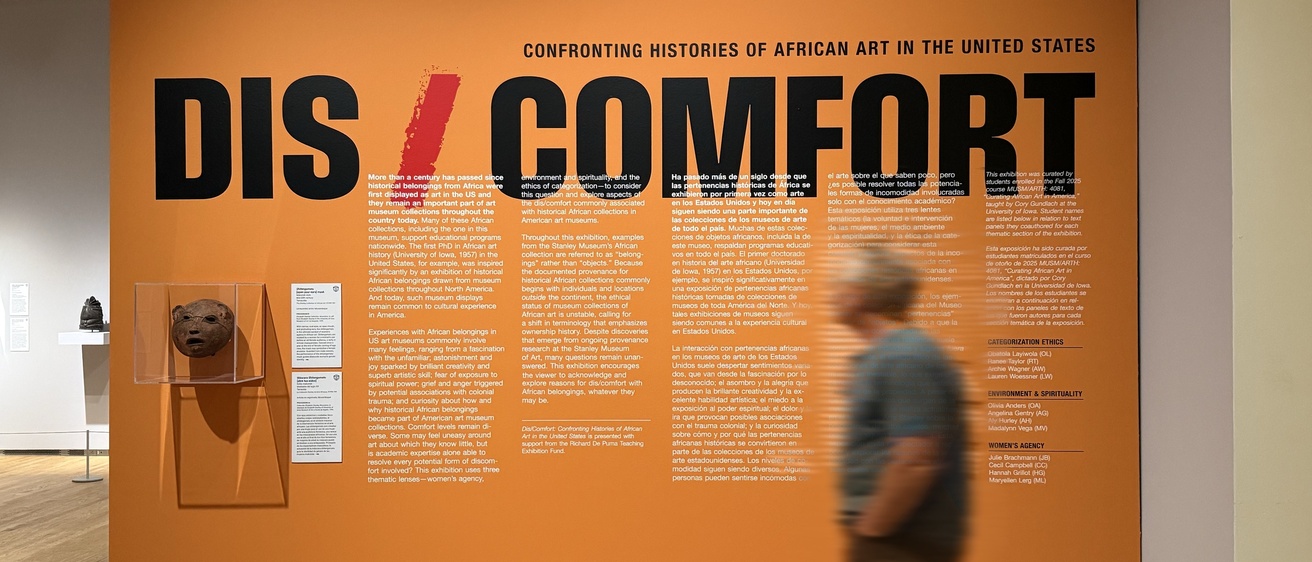
Walking through the exhibition Dis/Comfort: Confronting Histories of African Art in the United States, you won’t find the word “object” on a single label. The twelve students who curated the exhibition under the supervision of Cory Gundlach, Curator of African Art at the Stanley Museum of Art, made a deliberate choice to call everything on view a “belonging” instead.
A ceremonial spoon honoring the most hospitable woman in the community, a mask worn annually only by women, a staff that rested on a chief’s shoulder– none of it was intended to sit behind a glass case. “Object” doesn’t carry any of that context.
“These are belongings,” said Maryellen Lerg, a fourth-year art history student who worked on the show, “They belong to specific groups and specific contexts that inform their meaning and the way they’re used and interacted with.”
Dis/Comfort grew out of the course MUSM/ARTH: 4081, “Curating African Art in America,” taught by Cory Gundlach at the University of Iowa. Each class session, Gundlach introduced the class to a selection of belongings from the museum’s collection. Students discussed what the exhibition should convey about provenance, or ownership history, chose belongings to represent each section, and wrote labels for them.
Three of these students, Maryellen Lerg, Aly Hurley, and Obatola Layiwola shared their class experience.
Maryellen Lerg, Women’s Agency
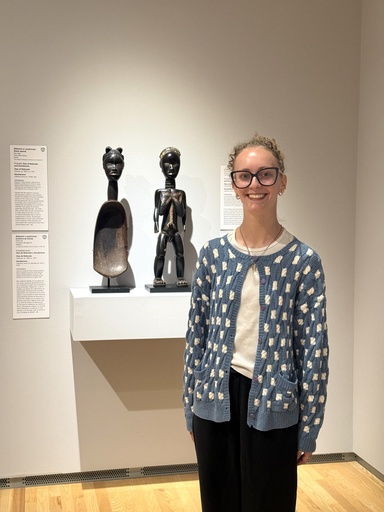
Lerg was part of the group that worked on the section, Women’s Agency, and was emotional walking into the exhibition space for the first time.
“This class was intense, but it was so rewarding.”
Coming up with a title for the exhibition was one of the most challenging parts, she recalls, “No one wanted to be the first to label it and just blatantly say Americans are uncomfortable around African art because of women’s agency, spirituality, and colonial histories. Once we were able to say what it was, that really helped us expand the idea and hash out what we meant, because it’s a difficult and delicate topic.”
Lerg wrote the label for Shitengamatu, a terracotta Makonde style mask that translates to “open your ears,” one of the only masks made for and used exclusively by women.
Having grown up in Iowa like many of her peers, Lerg was conscious about her lack of exposure to the communities whose belongings she was writing about. She credits her course instructor, Gundlach, for filling that gap and pushing the class to notice the significance of minor choices, like the difference between using the word 'village' versus 'community.'
“I needed to take a step back and analyze what I’m saying about communities that I’m not a part of,” she said. “He instilled a level of respect that I hope shows up in all of our texts.”
Aly Hurley, Environment and Spirituality
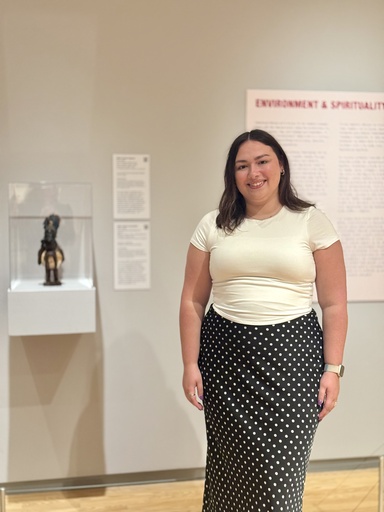
Aly Hurley completed her MA in Art History in Spring 2026. She was part of the group that worked on the section Environment and Spirituality, researching the provenance and writing the label for Ou tibi, a wooden headpiece representing bini oru (water spirit).
Provenance carries particular weight for a collection like this one. Much of African art that ended up in American museums moved through channels like colonial-era trade, private dealers, and estate sales that left thin or missing paper trails. Dis/Comfort doesn’t smooth that over– every label in the show details the chain of ownership openly, transfer by transfer, including the unverifiable gaps.
“I’d done provenance work before, but I’d never had access to the kind of information we had here like object files and collector files,” Hurley said. “It gave me a chance to be a bit of a detective.”
Hurley was able to trace the descendants of a dealer who had worked with Claude Maxwell Stanley and his wife, Elizabeth Stanley, the philanthropic family credited with the Stanley Collection of African Art. They had no records and recommended she reach out to the Smithsonian, where her investigation ended. Even without an answer, the search was worth it. “It was rewarding to reach out to these people, have them be excited to help, and connect me with others who might know more.”
Obatola Layiwola, Categorization Ethics
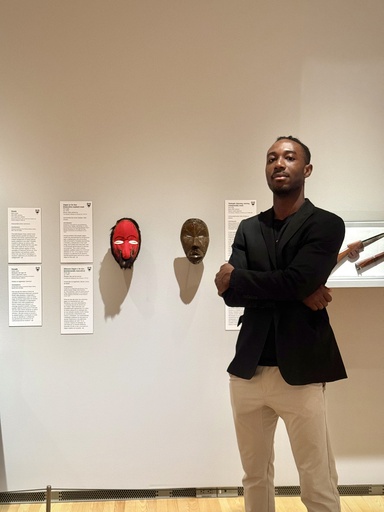
Obatola Layiwola, a third-year MFA candidate in graphic design, was part of the group woking on the third section of the exhibition, Categorization Ethics. He wrote the labels for two Dan-style masks and the Ogo Elegba dance staff, a Yoruba belonging with a Janus head representing Elegba, or Eshu, the trickster god, one face youthful, one elderly. Layiwola grew up in Nigeria until he was 17, and the dual masks and staff gave him a link to duality, a theme he often circles back to.
"There are a lot of cultural conversations about twins in African history," he said. His reference point was Ryan Coogler's film Sinners. "With masks, in a lot of rituals, performances, and festivals in Africa, a dancer or masquerade wears the mask and becomes a completely different person," he said. "Sometimes they're said to be possessed by a spirit, but they're human beings putting on a new persona."
The Ogo Elegba later became the subject of a side project that Layiwola worked with Associate Professor Björn Anderson on to create a 3D scan of it.
With a number of students weighing in, Hurley said the hardest part was “getting everyone on the same page, especially on the overall theme toward the end.” All the students credited Gundlach with holding the process together “very precisely” Layiwola said, while still leaving room for students to disagree.
They now each carry the experience gained from this class in different tracks.
Maryellen Lerg is pursuing an internship with the Grant Wood Art Colony’s Catalogue Raisonné Project and is also interning at the Stanley Museum of Art in Fall 2026.
Aly Hurley has since been offered a position at Asheville Art Museum as their IMLS Collections Project Registrar that is looking forward to starting soon.
Obatola Layiwola is starting his MFA thesis, partly inspired by this class on visualizing provenance data.
Dis/Comfort: Confronting Histories of African Art in the United States is on view at the Stanley Museum of Art through Spring 2027.
Admission to the museum all exhibitions is free.